
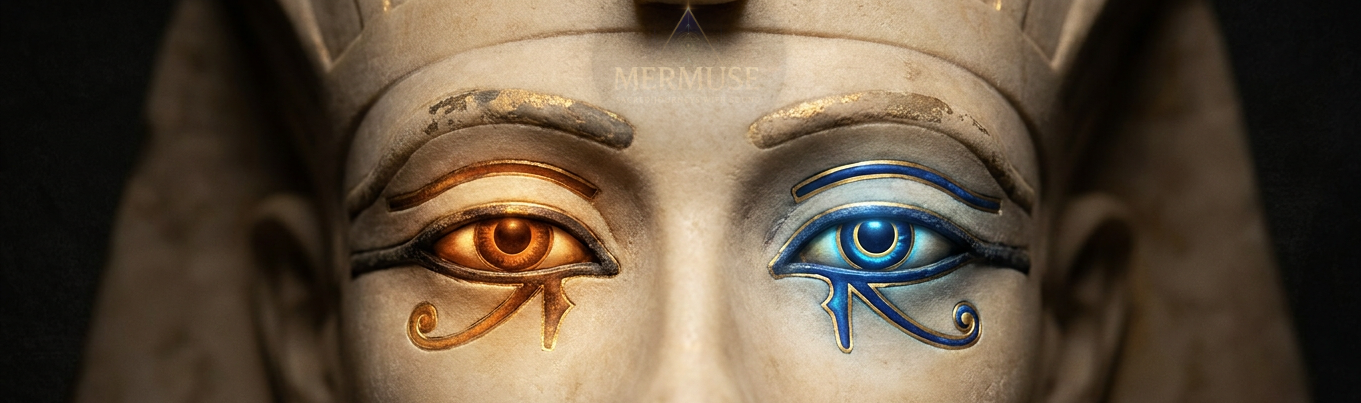
The Eye is one of the oldest and most persistent symbols in human history. It appears carved into ancient temples, worn as protection, embedded in myth, encoded in mathematics, and even resurfacing in modern systems of power and control. In ancient Egypt, this symbol takes two primary forms: the Eye of Horus and the Eye of Ra. Though often confused, they are not the same. They represent two distinct forces, and two different expressions of perception, consciousness, and power.

The Eye Of Horus: A math equation in an image
The Eye of Horus, also known as the Wedjat, originates from a myth of fragmentation and restoration. Horus loses his eye in battle, and it is later reassembled, made whole again. This restored Eye becomes a symbol not just of healing, but of completion and of something broken being returned to its full state.
The Egyptian word associated with it means “whole, sound, made complete,” and this idea is echoed in its mathematical use. The Eye was divided into fractional components; 1/2, 1/4, 1/8, 1/16, 1/32, and 1/64, used in measurement systems, yet never fully summing to one. There is always a missing piece, and in the myth, that final restoration comes through Thoth. This transforms the Eye into something more than symbolic becomes a model of consciousness itself, fragmented perception brought back into alignment through an unseen force.

Sekhmet and the power of Ra
In contrast, the Eye of Ra represents something more active, more forceful. It is associated with the sun, often linked to the right eye, and is described in ancient texts not as passive sight, but as something that can be sent out, something that acts. The Eye of Ra becomes embodied through powerful goddesses such as Sekhmet or Hathor, functioning as an extension of divine will capable of protection, judgment, or destruction. Where the Eye of Horus represents restoration and inner perception, the Eye of Ra represents projection, outward power, and the active force of awareness. Together, they form a dual system: perception restored within, and perception expressed outward. But the Eye in Egyptian thought goes even further. It was not just drawn or spoken about; it was offered, consumed, and embodied. In ritual contexts, offerings such as bread, beer, incense, and light were equated with the Eye itself. This suggests that the Eye was not only something one possessed, but something one aligned with and something internalized. It was not just about seeing, but about becoming capable of seeing.

Modern interpretations often connect the Eye of Horus to the pineal gland, noting the visual similarity between the symbol and a cross-section of the human brain. While there is no definitive evidence that the Egyptians intended this as an anatomical diagram, the symbolic resonance is striking. Across cultures, the pineal gland has long been associated with inner vision, consciousness, and what is often called the “third eye.” Whether literal or symbolic, the association reinforces the idea that the Eye represents perception beyond the physical senses; awareness that extends into something deeper. This concept is not unique to Egypt. The Eye appears across cultures in different forms but with similar underlying meaning. In Western traditions, the All-Seeing Eye represents divine awareness or oversight. In Hinduism, the third eye of Shiva symbolizes the destruction of illusion and the awakening of higher perception. In Norse mythology, Odin sacrifices one of his eyes to gain wisdom, trading physical sight for deeper understanding. In Celtic traditions, vision becomes internalized through trance, seership, and what is known as second sight. Though the symbols differ, the pattern remains consistent: true sight is not simply given, it is gained, often through transformation or sacrifice.


In modern times, the symbol of the Eye has taken on new layers, particularly through its association with the All-Seeing Eye in Freemasonry, currency, and conspiracy narratives. What was once a symbol of divine awareness and protection is sometimes interpreted as a symbol of surveillance or control. This shift does not necessarily change the meaning of the symbol itself, but rather reflects how it is being used. The Eye can represent awakening and perception, or it can represent being watched; it depends on perspective. But perhaps the most intriguing layer emerges when we return to ancient Egyptian texts describing the afterlife. These texts speak constantly of gates, doors, and passageways between worlds. In works like the Book of Gates and the Amduat, the soul must pass through multiple thresholds, each requiring knowledge, recognition, and the ability to perceive correctly. Passage is not automatic. It requires awareness. It requires understanding. It requires sight, not just physical sight, but a form of perception that has been restored and aligned.

There is no direct statement in ancient Egyptian texts that the Eye itself is a physical portal or stargate (or is there?), but there is a consistent system that describes gates, the need for awareness to pass through them, and the restoration of perception as central to that process. This leads to a powerful possibility: the Eye is not the gate, but the key.
The Eye of Horus represents perception restored to wholeness, yet I can’t help but think that the fractions and intervals mathematically displayed within it, those precise divisions of 1/2, 1/4, 1/8, and so on that may echo something far more familiar than simple measurement. They resemble tonal intervals, frequency relationships, the same mathematical language that governs sound and resonance. Maybe the Eye is not just symbolic of restored perception, but is actually depicting a harmonic system, a literal key of tones, a sequence or structure that could “unlock” something; not necessarily a physical door in the way we imagine, but a threshold of perception, a state of alignment. When viewed this way, the Eye of Horus becomes more than a restored symbol; it becomes a tuned system. The Eye of Ra then emerges as the active force that moves through that alignment, the power that can act through restored perception.

Dendera Relief, The Lunar Procession / Reconstruction of the Eye (Osiris as the Moon), brought to life
Together, they form a system of transformation; one in which the body is prepared, the mind is aligned, perception is restored, and passage becomes possible. In this sense, the Eye is not simply watching; it is tuning, a mechanism through which reality is understood, navigated, and perhaps even transcended. Across cultures and across time, the Eye continues to appear not just as a symbol, but as a question, not “who is watching,” but “are you truly seeing?” Because in every tradition where the Eye appears, the same truth emerges: sight is not passive. It is something that must be earned. And once it is, nothing is ever perceived the same way again.
Sources and Further Readings
The Complete Gods and Goddesses of Ancient Egypt
The Ancient Egyptian Pyramid Texts
The Egyptian Book of the Dead
The Book of Gates
The Amduat
Serpent in the Sky
